

MultiTaLe organized its first ever event on May 7th with a title Swipe Left Tampere! Panel Discussion. MultiTaLe (Multilingual and Multicultural Tampere Left) is a working group under Tampere Left. The purpose of MultiTaLe is to extend Tampere Left better to the direction of people from different backgrounds.
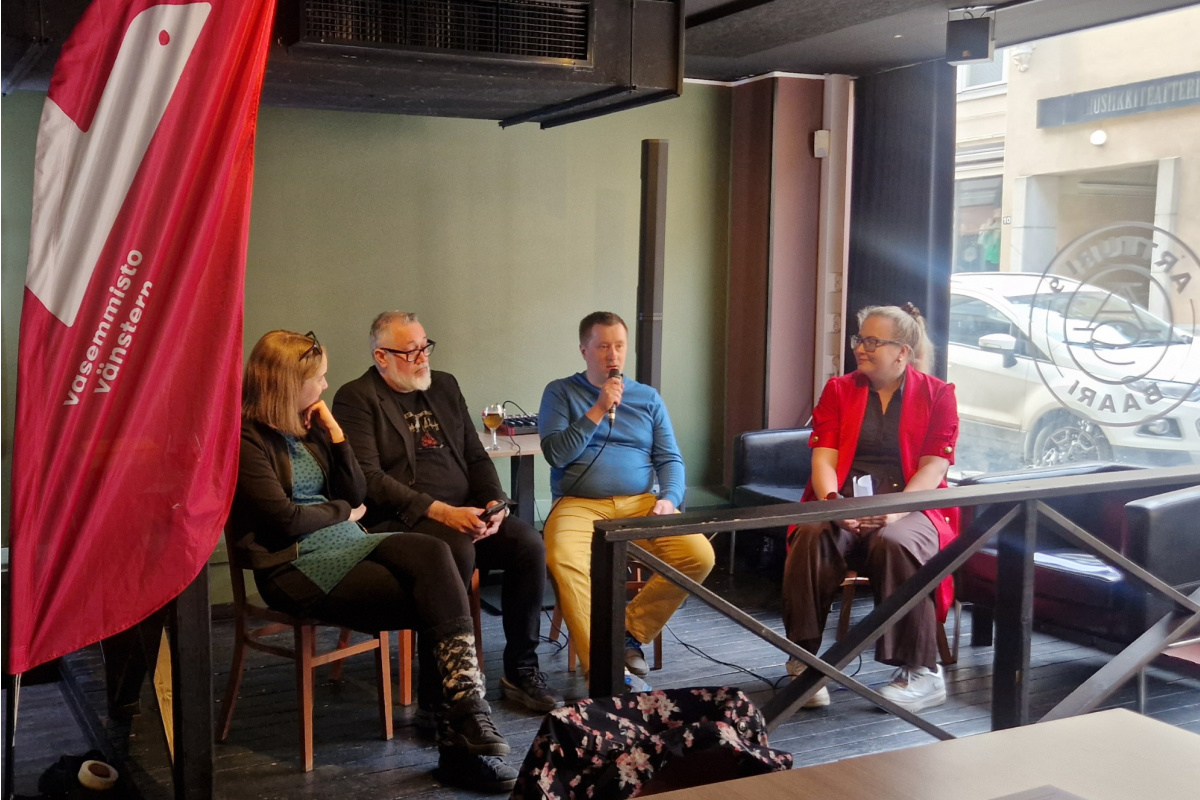
The topic of the first event was a panel discussion. This time the discussion took the form of a Q&A (questions and answers) discussion between active party members. Ida Savinainen (she/her) facilitated a discussion between Alex Miettinen (he/him), Simon Riestra (he/him) and Milka Hanhela (she/her). Alex and Simon had migrated to Finland decades ago. Milka participated in the discussion in the role of a current chairperson of Tampere Left.
There were 15 people from different backgrounds present, and a few more listening with one ear from the far side of Artturi 9, the bar where the event took place.
What did we learn from this Discussion?
The role of language-learning came up a few times from everyone. Most of Finland is Finnish-speaking, and knowing the mother tongue of the locals gives an easier way to connect with them. Simon pointed out that the difference of knowing Finnish allows for a more vivid, richer experience of Finland. It was clear that knowing Finnish in Finland will give a kind of access to the culture that won’t be accessible without the language even if a lot of the culture can be digested even without language.
The key services (school, health care etc) are available here in Tampere for people who don’t speak Finnish. Still, as Milka pointed out, the current situation has been made possible by the work of the Left Alliance and our like-minded councillors in the city council. Things have improved throughout the years. A participant also reminded us in the informal after-discussions that even if services are available in other languages, a person in need of those has to have certain skills or rely on someone’s help to be able to find them.
Learning a language is not a simple thing. A lot of our understanding of the world is based also on the knowledge of our first language. Knowing one’s first language well helps further language-learning, Milka reminded us. There is no better environment to start than the immersion to the early childhood discussions and learning the language through play and bedtime stories – after that, the learning continues in a more formalized fashion to help people develop their understanding of what they know intuitively. This works well in early childhood, but for adults, this way of language-learning is not for everyone.
Good language-learning structures allow these people to know several languages to the mother tongue level, which is actually a sought-after superpower in the more globalized world as Milka reminded us: even if in Finland, a person’s language-skills are stupidly mostly seen as strengths only if they also know Finnish.
Simon reminded us that a person can do a lot to help their own language-learning process – and learning to use the language is largely a matter of tenacity by the learner. Alex pointed out the worth of environments: relaxed learning is often much more accessible and effective than formal classroom settings. He gave an example of a language cafés, and Simon mentioned public saunas as the key places to learn Finnish language and culture.
Meetings Build Understanding and Possibility for Change
Different intermingling spaces where different cultures can meet and learn from each other are something vital to the future of Tampere.
Simon offered us a more tactical, historical view to counteracting racism. When he moved to Tampere, we were in the middle of the Nokia boom, but when the structures of the society didn’t adapt to the times, people got sad and lonely. Half of the people live alone with killing loneliness. COVID-19 showed this in a very concrete way. The right took hold of this loneliness, and offered racism as a solution.
Paradoxically, racism they do in politics takes away funding from relevant organizations and from language-education, and allows international recruitment practices with a high risk for labour-based abuse. Both of these push people to the corner instead of welcoming them with open arms.
Simon thinks that we should naturally express that racism has no room in Tampere but have to be mindful when and how. We can meet people’s disgust with our disgust, but for the sake of future generations it is often more fruitful to meet the hate with exemplary behaviour instead.
Alex also sees racism as a strong class theme. Better-off people have an easier time allowing diversity and contributing to society in general. When your life doesn’t have many opportunities, that makes it more difficult to even care for traffic rules or our common environments.
The consensus was that it is actually capitalism that makes us sad and hate each other.
What do we need to do for people to feel more welcome? Simon offered a solution as working towards a more enjoyable, softer world. As Alex put it: ”Everybody wants a village but nobody wants to be a villager.” Tampere Left has the potential to grow into this enjoyable soft and welcoming village if we just make the effort to become exemplary villagers.
What does Tampere Left do?
Ida told us that the number of people whose mother tongue is not Finnish increases with thousands of people every year here in Tampere. At the core of Left politics is to work in creating more accessible, more welcoming Tampere to everyone. Naturally we at Tampere Left should also mirror this principle in our own activities: to really grow into a grassroots-organization that extends to all kinds of people. This was one of the reasons why Tampere Left newsletters are nowadays always translated into English. The purpose of MultiTaLe is simply to create more participation opportunities for people whose mother tongue is not Finnish or whose home culture is a combination of different cultures.
Alex reminded us to think about the digestibility and amount of the information. Simon emphasized the value of language-learning environments. Milka sees that Tampere Left can create opportunities for different people to join. Simon agreed, but reminded that not everyone who moves to Tampere is actually left-aligned. Both agreed that people should be able to attach themselves to the activities that align with their values.
If you want to join us in creating a more accessible Tampere Left for everyone, please contact the MultiTale working group, and let us know you are interested. You can join our mailing list through here.
The next Swipe Left event on June 22nd at 17:30 is called Let’s Play Mölkky. We hope to see you there!


